Akbar Ahmed’s documentary explores place of Islam in European history, civilization–Raif Karerat, The American Bazaar

Raif Karerat of The American Bazaar has given advanced praise to the forthcoming Journey Into Europe project. Check out his article to learn more about our exciting documentary!

As China Awakens, America — And Pakistan — Should Take Note

The World Post – The Huffington Post

This article also appears in the August-September 2015 issue of All China Review.

By Akbar Ahmed

Photo: Kevin Frayer via Getty ImagesFORBIDDEN CITY MAO

BEIJING — “When China wakes, she will shake the world.” Napoleon’s famous comment on China has had China-watchers scratching their heads for two centuries as to what exactly he meant. Was it a warning to Europe of a potential threat from the East? Or was he reflecting upon the fascination of his time with Chinese culture and its silks and ceramics?

We may know the answer soon. China is awake and stirring. News of building projects and economic initiatives across the globe, including in its remote areas, are a testimony. So are some of the statistics. Take these at random: a Chinese billionaire is said to be created every week; China’s space program is aiming for Mars; China has over 20 million students in higher education and some quarter of a million students in the United States. It can even boast the ultimate sign of wasteful conspicuous consumption — Chinese students in the U.S., children of the elite, driving luxury cars.

Chinese films like Crouching Tiger, Hidden Dragon, 2000, established the fact that the new China could produce technologically and artistically sophisticated films that could win awards in the West and yet still proudly celebrate its own cultural traditions.

The scale of China’s dramatic success has settled one great contemporary philosophic debate — the superiority of Capitalism over Marxism, which the Chinese say in private is now as dead as a dodo — while opening another. Which is better, an open democratic system, however noisy and unpredictable, or a highly centralized and controlled one? The U.S. and other democracies argue for the former; China is the living example of the latter.
To continue reading, click here.

University Club of Washington hosts Iftar, lecture

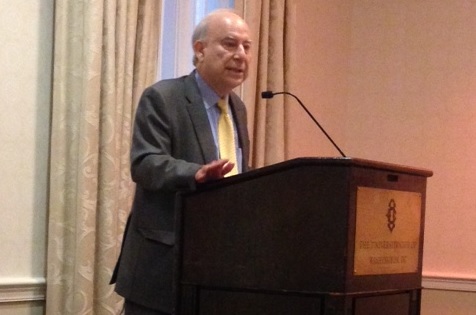
Akbar Ahmed introduces core Muslim tradition to DC audience.

By Patrick Burnett

Akbar-Ahmed-speaks-at-University-Club-of-Washington-DC-iftar1

The University Club of Washington, DC’s International Committee graciously hosted a wonderful talk by Ambassador Akbar Ahmed and a delicious Iftar dinner of the customary dates, Moroccan Hariri soup, Lamb Tagine, and baklava, on June 24, attracting distinguished guests from the prominent private Washington club, including key officials from the Pentagon and the German Embassy.

Ahmed, the Ibn Khaldun Chair of Islamic Studies at American University and the former Pakistani High Commissioner to the UK, took the opportunity to introduce and tie together his Sufi-influenced poetry with the roles of love and ‘ilm’ in Islam for this prominent audience. Ahmed also explained the significance of Ramadan and the month’s beautiful and selfless traditions to this mostly non-Muslim audience, while also emphasizing how fasting unites all of us within the world’s faiths. Fasting as a means to deeper spirituality is not exclusive to Islam, but all the world’s great religions — whether the Abrahamic faiths, Hinduism, or Buddhism…

To continue reading, click here.

Some Right-Wing Europeans Say Islam Hasn’t Contributed to Western Culture. Here’s Why They’re Wrong.

The World Post – The Huffington Post

By Akbar Ahmed

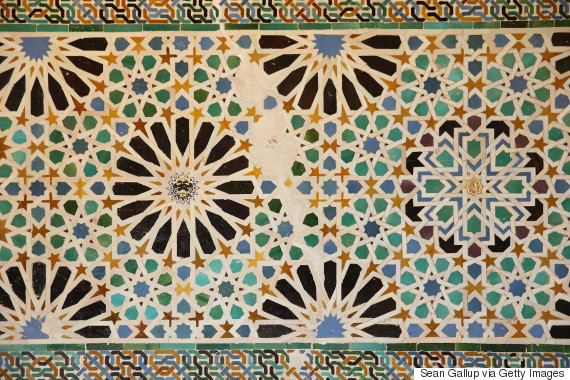
GRANADA, SPAIN - JULY 20: Intricate tile and mosaics decorates a room in the Nasrid Palaces at the Alhambra on July 23, 2013 in Granada, Spain. Southern Spain is among Europe's biggest tourist destinations. (Photo by Sean Gallup/Getty Images)

One of the right-wing tropes about Islam in Europe, which is making alarming inroads into the mainstream, is that it represents a “culture of backwardness, of retardedness, of barbarism” and has made no contribution to Western civilization. Islam provides an easy target considering that some 3,000 or more Europeans are estimated to have left for the Middle East in order to fight alongside the Islamic State. The savage beheadings and disgusting treatment of women and minorities confirm in the minds of many that Islam is incompatible with Western civilization. This has become a widely known, and even unthinkingly accepted, proposition. But is it correct?

Let us look at European history for answers. At least 10 things will surprise you…

What Europe Should Learn From Bosnia

The World Post – The Huffington Post

By Akbar Ahmed

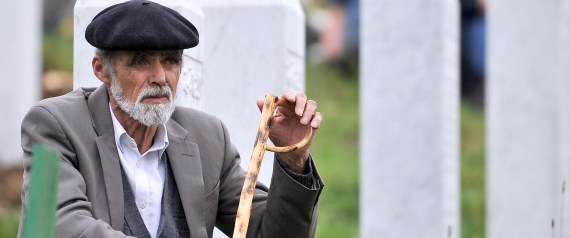
BOSNIA-WAR-SREBRENICA-ANNIVERSARY

Europe today is witnessing a major crisis concerning its Muslim communities, one which is already beginning to reveal its troubling global implications. I believe Europeans have much to learn from tiny Bosnia, tucked away in a remote part of the continent. Let me explain.

Europeans feel under siege. Wherever they look, they are confronted with appalling stories of violence and moral turpitude associated with Muslims — the Charlie Hebdo killings in Paris followed by the attacks in Copenhagen; Muslims assaulting members of the Jewish community in schools, museums and even markets; and Muslims in the U.K. are condemned for both “grooming,” that is, exploiting young girls for sex by getting them addicted to drugs and drinks and “Trojan Horse” strategies designed to take over schools and impose an Islamic agenda.

In turn, Muslims also feel under siege. Right-wing parties have grown dramatically with a negative focus on Muslims and contest most Muslim-related issues, including, for example, that of rescuing immigrants at sea, which they depict as opening the floodgates to “millions” of potential terrorists. Huge processions numbering up to 25,000 have been organized by Pegida against Muslims. (To her credit, Mrs. Merkel, the chancellor of Germany, spoke at an anti-Pegida rally organized by Muslims in Berlin). Women in hijabs and mosques, both seen as symbols of Islam, have been frequently attacked. Three mosques were targeted in rapid succession even in traditionally peaceful Sweden. As a consequence of the negative reports about them, Muslims tend to see media as one-sided and biased.

In the midst of this ugly confrontation what can Bosnia teach us?

To continue reading, click here.

“To Combat the ‘New Anti-Semitism,’ Europe’s Jews and Muslims Must Work Together”

The World PostThe Huffington Post

By Harrison Akins

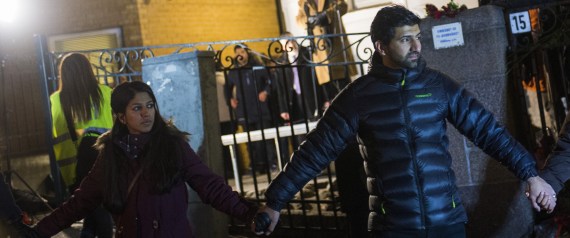
NORWAY-DENMARK-ATTACKS-ISLAM-JUDAISM

With news reports of continued anti-Semitic attacks against the Jewish community in Europe, it is all too easy to fall into a pessimistic view of the future of Jews’ place there. Some are asking the question of whether or not Jews should be leaving for safer shores. Israeli Prime Minister Benjamin Netanyahu has even made appeals to European Jews to immigrate to Israel.

The blight of anti-Semitism has haunted Europe for over a millennium and is still evident today. Recently, a new manifestation of anti-Semitism has arisen from within the Muslim population in Europe, a population that both dwarfs the Jewish community and continues to grow.

There is no denying the serious problems that exist between the Jews and Muslims of Europe. But do negative reports of those relations paint the whole picture?

Over the past two years, I have been traveling as part of the research team of Ambassador Akbar Ahmed, the chair of Islamic studies at American University, on a book and film project called “Journey into Europe.” We have been studying Islam in Europe, broadly speaking, and an important aspect of the project has been examining the relations between Jews and Muslims.

To continue reading, click here.

What Andalusia Can Teach Us “Today About Muslims and Non-Muslims Living Together”

Huffington Post – The World Post

By Akbar Ahmed

SPAIN-RELIGION-ISLAM-CHRISTIANITY-CULTURE

“The loss of Andalusia is like losing part of my body,” H.R.H. Prince Turki al-Faisal told me.

I had asked him what the loss of Andalusia meant to him as an Arab. The son of King Faisal, widely celebrated in the Muslim world, Prince Turki heads The King Faisal Center for Research and Islamic Studies in Riyadh, Saudi Arabia’s preeminent think tank, and has been Saudi ambassador to the U.S. and the U.K. The question had excited the normally taciturn prince. The mask of cultural and royal impassivity developed over a lifetime of diplomatic dealings had dropped as his body and voice expressed high emotion. The image of Andalusia had struck a nerve: “The emptiness remains.”

When I asked him what Andalusia meant to him, he replied, “I have a passion for Andalusia because it contributed not only to Muslims but to humanity and human understanding. It contributed to the well-being of society, to its social harmony. This is missing nowadays.” For the prince, “Andalusia was the exact opposite of Europe at that time — [then] a dark, savage land of bigotry and hatred.”

At its height, Andalusia produced a magnificent Muslim civilization — religious tolerance, poetry, music, learned scientists and scholars like Averroës, great libraries (the main library at Cordoba alone had 400,000 books), public baths, and splendid architecture (like the palace complex at the Alhambra and the Grand Mosque of Cordoba). These great achievements were the result of collaboration between Muslims, Christians and Jews — indeed the work of the great Jewish Rabbi Maimonides was written in the Arabic language. It was a time when a Muslim ruler had a Jewish chief minister and a Catholic archbishop as his foreign minister. The Spanish had a phrase for that period of history — La Convivencia, or co-existence…

To continue reading, click here.

Ambassador Ahmed Discusses Islamophobia on CCTV’s The Heat

“To Understand Europe’s Immigration Crisis, Listen to the Voiceless ‘Illegals'”

Huffington Post

By Akbar Ahmed

MEDITERRANEAN MIGRANTS
Today there is so much being said about Muslim immigration in Europe. Yet it is all too often in the abstract — we don’t usually meet those who are involved or hear their stories.
Last year, over 3,000 died trying to reach Europe, and the over 170,000 who managed to make it to Italy looked forward to what is often an extended period of misery as they encountered confused and sometimes contradictory European policy towards them. In the last week alone, Italy rescued around 4,000 migrants from the sea.
The immigrants who arrive enter the category of “illegal” and live in the shadows of Europe. To understand their plight and the challenges they are creating for European countries, I wanted to speak to the people involved, both the immigrants themselves and representatives of European governments who are dealing with them. With the current humanitarian emergency, notably in the Mediterranean where so many continue to die, it is crucial to hear their stories. Perhaps then we can gain some insight into what needs to be done to alleviate this monumental crisis.
It is for this reason that I launched the Journey into Europe project to study the Muslim communities of Europe, which has taken myself and a research team across the length and breadth of Europe, from France and Germany to Greece and Bosnia. In Catania, Sicily, in the last wintery days of 2014, I made the acquaintance of a 16-year-old boy from Gambia. It is important for all of us to hear what he has to say.

To continue reading, click here.

Ambassador Ahmed discusses European Muslims joining ISIS on BBC World News