Category Archives: Project Activities

Ambassador Ahmed and team join distinguished interfaith roundtable with State Dept. delegation from Pakistan and Afghanistan

img_1953

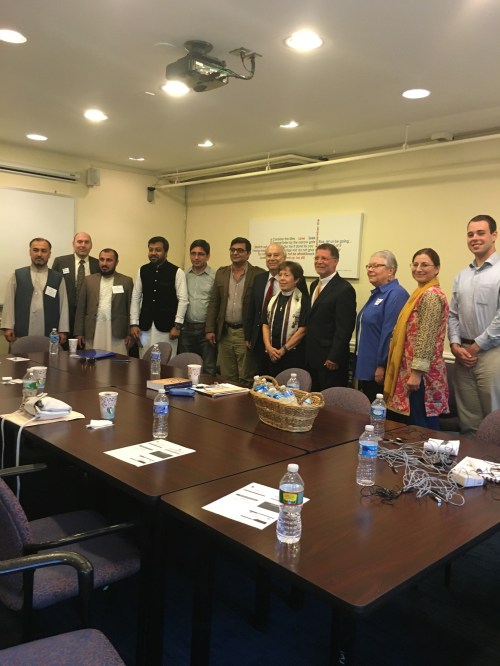
Ambassador Akbar Ahmed (center), Dr. Amineh Hoti (right), and Patrick Burnett (right) join a distinguished interfaith roundtable featuring a visiting delegation from Afghanistan and Pakistan at the National Cathedral  on September 9. The roundtable featured top interfaith leaders from Greater Washington engaging with government officials and scholars from Pakistan and Afghanistan.

On the morning of Friday, September 9, Ambassador Akbar Ahmed and team members Dr. Amineh Hoti and Patrick Burnett joined a distinguished roundtable of Greater Washington interfaith leaders at the Church House of the National Cathedral to welcome and speak with five visitors from Afghanistan and Pakistan. The visitors are touring the US as part of the US Department of State’s International Visitor Leadership Program, conducted under the auspices of the Meridian International Center. The purpose for the visit of these distinguished government officials and scholars is to explore “religious dialogue influencing foreign policy” as part of a State Department Sub-Regional Project for Afghanistan and Pakistan.


The visiting delegation took the opportunity during this two-hour closed-door session to explore some of the challenges American interfaith leaders have faced in working to build bridges between different faith communities, particularly in the years since 9/11, and seek advice for how to overcome some of the great obstacles individuals and communities face in trying to come together and overcome differences.


Ambassador Ahmed, hailing from Pakistan and having worked extensively as a Commissioner in the Tribal Areas, was able in particular to poignantly illustrate to the delegation the importance of knowledge and understanding, as well as the importance of reaching out directly to both leaders and community members in order to build bridges. He made a strong plea to the Pakistani and Afghan leaders at the roundtable to not fall into the trap of many American Muslim leaders immediately following 9/11, who frequently echoed the hollow phrase, “Islam is a religion of peace,” as people were cynical and did not believe it to be so in light of the attacks. Fifteen years since 9/11, Ahmed emphasized that the challenge remains for Muslims to convince the world that their religion is one of peace and for the world not to indulge in Islamophobia – issues that remain at the fore of global affairs today.

2016-09-12-photo-00000068

Ambassador Ahmed (center right) and Dr. Hoti (center) discuss  the importance of engaging non-Muslim communities around the globe as Muslim leaders with the visiting delegation.


Ahmed also stressed the importance of overcoming differences within one’s community and making a stand against those oppressed groups in their own society, while also emphasizing to the delegation the importance of having their voices heard both as interfaith leaders and as ambassadors of Pakistan and Afghanistan in a time when so many in the West grossly misunderstand the politics, culture, and society of these two nations. Without greater understanding in the West, Ahmed argued that it would continue to be difficult for American Muslims to make a strong case for themselves.


Following the roundtable conversation, the visiting delegation took a detailed tour of the National Cathedral and had a chance to learn more about Christianity, particularly the Episcopalian denomination. In the coming weeks, the visiting delegation will be traveling around the US further exploring how American interfaith practices are conducted.


2016-09-12-photo-00000067

A delegation of leaders from Afghanistan and Pakistan discuss the challenges of interfaith dialogue with leading interfaith practitioners from Greater Washington at the National Cathedral on Sept. 9. The visit was part of a nationwide tour for Pakistani and Afghan government officials and scholars sponsored by the US Department of State, under the auspices of the Meridian International Center.


The program was facilitated by Rev. Carol Flett, the Interreligious Officer for the Episcopal Diocese of Washington and former Interfaith Programs Coordinator at the National Cathedral. The Washington-based delegation, in addition to Ambassador Ahmed and Islamabad-based Dr. Hoti, included Rabbi Bruce Lustig of the Washington Hebrew Congregation, Ann Korky, a retired US Foreign Service officer and active lay member of the Episcopal Diocese of Washington, and Alan Ronkin, the Regional Director for the Washington office of the American Jewish Committee. Representing the delegation from Afghanistan and Pakistan were Mr. Sayed Muzammel Ferqat, the Director of the Secretariat of Afghanistan Moderation Center; Dr. Noorullah Kawsar, the Chief Editor, of Esteqamat (monthly) and a Lecturer at the Sayed Jamaludin Institute of Higher Studies; Professor Junaid Iqbal, a Religious Scholar and a Senior Anchorman for A Plus TV, Dr. Mohammed Khan, Assistant Professor in the Department of Social Sciences at Iqra University and Visiting Faculty at National Defense University Islamabad, and Professor Khurshid Ahmad, a Lecturer in the Department of International Relations at the University of Peshawar.
Islam and the West: Promoting the Dialogue of Civilizations—Ambassador Akbar Ahmed – National Presbyterian Church

Islam and the West: Promoting the Dialogue of Civilizations–Ambassador Akbar Ahmed from The National Presbyterian Church on Vimeo.

Ambassador Ahmed welcomes former Pakistan Foreign Minister Shah Mahmood Qureshi to American University

IMG_1650

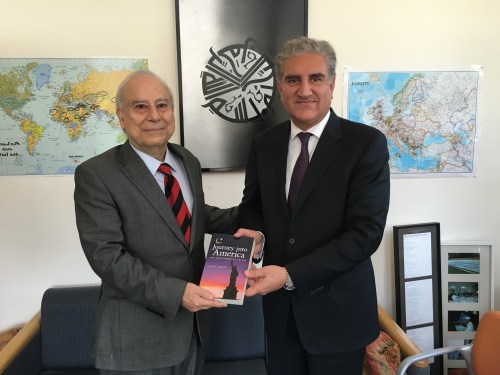
Ambassador Ahmed (left) presents Former Pakistan Foreign Minister Shah Mahmood Qureshi (right) with an autographed copy of his book, Journey into America: The Challenge of Islam in Ambassador Ahmed’s office prior to an intimate luncheon at American University.

On Wednesday, August 3rd, Ambassador Ahmed was honored to host distinguished guests Former Pakistan Foreign Minister Shah Mahmood Qureshi, Ambassador Nasir Khan, Senator Abdullah Riar, and Mr. Zain H. Qureshi at American University for an intimate luncheon. The luncheon was the Pakistani delegation’s final stop on their visit to Washington. The delegation was received by Ambassador Ahmed, Mr. Arsallah Khan Hoti, a senior member of the Privatisation Commission of Pakistan, and Special Envoy Arsalan Suleman, the acting U.S. Special Envoy to the Organization for Islamic Cooperation, and Patrick Burnett, assistant to Ambassador Ahmed.


Once settled, the delegation was welcomed to the University by Dean James Goldgeier, Dean of the School of International Service, Dr. Louis Goodman, Dean emeritus of the School of International Service, and Ambassador Anthony Quainton, Distinguished Diplomat-in-Residence in the School of International Service and former U.S. Ambassador to Nicaragua, Peru, Kuwait, and the Central African Empire. Ambassador Ahmed also presented His Excellency The Foreign Minister with an autographed copy of his book, Journey into America: The Challenge of Islam (2010), as well as a copy of his newest film, Journey into Europe (2015).
After receiving a warm welcome to the University and learning more about the activities of the School of International Service and the Ibn Khaldun Chair of Islamic Studies, the delegation was then treated to lunch in the Terrace Dining Room (TDR) at American University, organized by Elisa Frost, Research Assistant to Ambassador Ahmed, allowing the honorable gentlemen to experience the culinary delights of American campus life while further discussing the work of both Ambassador Ahmed and His Excellency The Foreign Minister.

IMG_9390

Ambassador Akbar Ahmed (center), Former Pakistan Foreign Minister Shah Mahmood Qureshi (center-right), and Pakistani Ambassador Nasir Khan (center-left) gather with their delegations in the Terrace Dining Room at American University after an intimate luncheon to welcome His Excellency The Foreign Minister and his delegation to American University. The luncheon was the delegation’s final stop on their visit to Washington.

Bradford comes of age – Amb. Akbar Ahmed, The Friday Times

Akbar Ahmed on the many faces of Bradford – including the ones that are conveniently ignored.

warsi

Amb. Akbar Ahmed with Baroness Sayeeda Warsi and her husband Iftikhar Azam at the Zoya Pakistani restaurant in Bradford. 


For several decades, the image of the Muslim community of Bradford, and the region around it, has been depicted in the media as that of angry-looking, white-bearded Pakistani men dressed in shalwar-kameez demanding the death of Salman Rushdie. Today, however, it is that of educated, intelligent smart women – also with a Pakistani background.

Bradford in the popular British imagination has long meant Islamic fanaticism and fundamentalism, urban crime, drugs and poverty. It has also more recently been associated with such phenomena as “grooming”, terrorism and the shariah-dominated “no-go zones” – defined by Islamophobes as places where non-Muslims ‘fear to tread’. Feeding in to these perceptions was the news last year that three Bradford sisters and their nine children had traveled to Syria to join ISIS together. Terrorism experts tend to look at dense communities like Bradford as hubs of terrorism producing an endless stream of recruits. It is for this reason that the government is constantly placed in the awkward position of implementing extreme measures only to come up with embarrassing results, such as the case of the young schoolboy who was arrested and taken for interrogation when he wrote in a school assignment that he lived in a “terrorist” house when he meant “terraced.” Bradford has thus been labeled a breeding ground for terrorist activity, which has made the city a particular target of the British government’s “Prevent” security strategy, a program that is increasingly being seen as coercive and unfair by the Muslim community. British Muslims use terms like “thought police” and “big brother” when discussing Prevent.

To continue reading, click here.

SOAS Centre for the Study of Pakistan (CSP) Annual Lecture 2016: Short video reflecting upon Amb. Ahmed’s address with Lord Bhikhu Parekh

Dr. Todd Landman, Pro-Vice Chancellor of the Faculty of Social Sciences at the Univ. of Nottingham, discusses Amb. Ahmed visit to Nottingham in context of Orlando tragedy.

“Last month The University of Nottingham welcomed Professor Akbar Ahmed, former High Commissioner of Pakistan to the UK and now the Ibn Khaldun Chair of Islamic Studies at American University in Washington DC as part of a three-day event to build trust between the Muslim and non Muslim communities of Nottingham. His speech was frank about the non-Muslim community vilifying all Muslims and grouping them together as a homogenous radical and terrorist force. He was equally frank in urging the Muslim leaders present at his lecture and those whom they represent to be stronger in their condemnation of all violence being committed in Islam’s name.”

To read more, click here.

Journey into Europe’s Global TV Premiere begins Monday on N1 in Bosnia

N1 in Bosnia, beginning this Monday, will be airing Journey into Europe, subtitled in Bosnian in four parts. Each part will play every Monday in June, corresponding with the month of Ramadan. To learn more (in Bosnian), please visit the N1 website here.

Journey into Europe to screen at the Bradford Literature Festival, Saturday, May 28, 6p

Anthropologist, Islamic scholar and filmmaker Ambassador Akbar Ahmed explores Islam in Europe and the place of Islam in European history and civilization in this unprecedented study. Shot across the continent in countries including Germany, the UK, France, Spain, and Bosnia, the film introduces us to people from all walks of life: presidents and prime ministers, archbishops, chief rabbis, grand muftis, heads of right-wing parties, and everyday Europeans from a variety of backgrounds.

Join Ambassador Akbar S Ahmed, the Ibn Khaldun chair of Islamic Studies at American University in Washington, DC, for a Q&A after the film.

Tickets: £6
Venue: National Media Museum – Cubby Broccoli Cinema

For more information, please visit the Festival website here.

Ambassador Ahmed visits SOAS, screens Journey into Europe and delivers lecture to full-house audiences

SOAS JIE

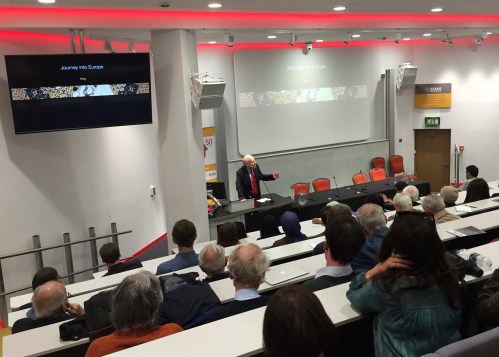
Ambassador Ahmed addresses the audience prior to the Journey into Europe screening.

On May 21, Ambassador Ahmed spoke at a screening of Journey into Europe held at the School of Oriental and African Studies (SOAS) in London to a packed hall. The event was hosted by two key partners and patrons of the Journey into Europe project, Professors Amina Yaqin of SOAS and Peter Morey of the University of East London. Attending the screening were distinguished guests including His Excellency Syed Ibne Abbas, the Pakistani High Commissioner to the UK, as well as prominent figures who appear in the film including Sir Nicholas Barrington, the former British High Commissioner to Pakistan, the author and activist Kristiane Backer, and Mohsin Akhtar, the owner of Heydon Grange golf course and farm outside of Cambridge. The film received a very enthusiastic response from the audience. Frankie Martin, who is leading the research team for the project and is the associate producer and assistant editor of the film, joined the panel discussion for the question and answer session following the screening and shared his experiences and ideas working on the project.


The occasion had added significance for Ambassador Ahmed because he received his PhD at SOAS, in 1978. Ambassador Ahmed’s PhD tutor, Adrian Mayer, was in the audience for the film. The previous evening, May 20, Ambassador Ahmed gave the Annual Lecture, “ISIS, Paris, Pakistan and the search for peace: conversations with an Islamic scholar,” also to a packed hall, which was moderated by the prominent political theorist Lord Bhikhu Parekh. Among the audience attending the event, which was also received very enthusiastically, were many SOAS alumni. Prominent guests included Sir Nicholas Barrington, Justice Khurshid Drabu, the first secretary and the defense attache at the Pakistan embassy, Jonathan Benthall, the former Director of the Royal Anthropological Institute, and many others.

SOAS Hall of Fame

Ambassador Ahmed poses next to his portrait on the SOAS “hall of fame” for distinguished alumni.

Amb. Ahmed calls on US Deputy Chief of Mission in London to discuss Journey into Europe

US Embassy Visit 2

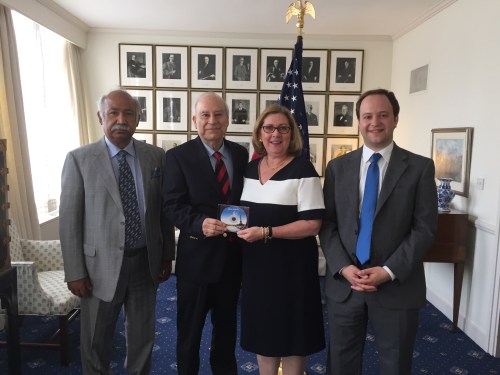
Ambassador Ahmed presents the Journey into Europe film to DCM Elizabeth Dibble

On May 19, Ambassador Ahmed visited the US Embassy in London and called on the US Deputy Chief of Mission, Elizabeth Dibble, in order to discuss the Journey into Europe project and present a copy of the film. Ambassador Ahmed had previously met Ms. Dibble last year at an important conference on Islam hosted by the Ditchley Foundation outside of Oxford. Ms. Dibble appreciated the project and its aims and was delighted to receive the film. Also attending the meeting was Mohsin Akhtar, the owner of Heydon Grange golf course and farm outside of Cambridge, Frankie Martin, a member of the Journey into Europe team, and Anneliese Reinemeyer, the Cultural Affairs Officer at the US Embassy in London, who will also attend the screening of Journey into Europe at the School of Oriental and African Studies in London on May 21.

US Embassy Visit 1

From Left to Right: Mohsin Akhtar, Ambassador Ahmed, DCM Elizabeth Dibble, and Frankie Martin