Bradford comes of age – Amb. Akbar Ahmed, The Friday Times

Akbar Ahmed on the many faces of Bradford – including the ones that are conveniently ignored.

warsi

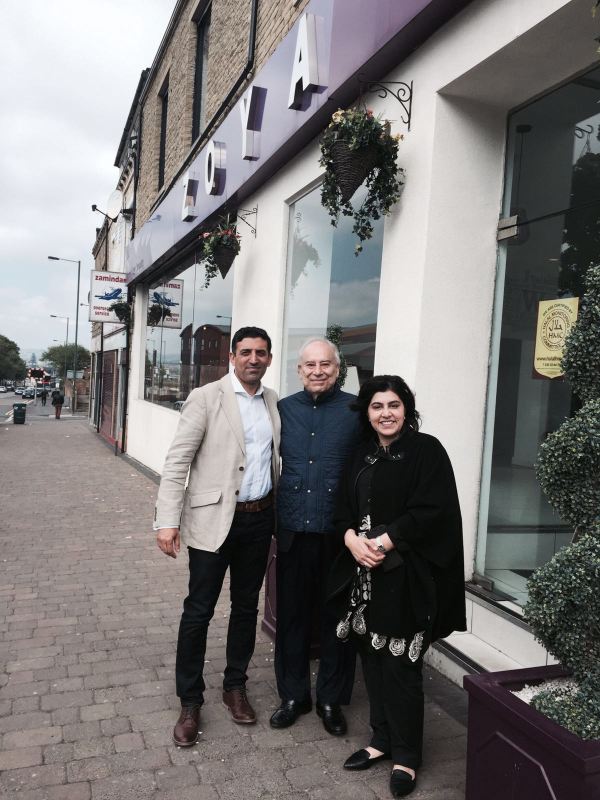
Amb. Akbar Ahmed with Baroness Sayeeda Warsi and her husband Iftikhar Azam at the Zoya Pakistani restaurant in Bradford. 


For several decades, the image of the Muslim community of Bradford, and the region around it, has been depicted in the media as that of angry-looking, white-bearded Pakistani men dressed in shalwar-kameez demanding the death of Salman Rushdie. Today, however, it is that of educated, intelligent smart women – also with a Pakistani background.

Bradford in the popular British imagination has long meant Islamic fanaticism and fundamentalism, urban crime, drugs and poverty. It has also more recently been associated with such phenomena as “grooming”, terrorism and the shariah-dominated “no-go zones” – defined by Islamophobes as places where non-Muslims ‘fear to tread’. Feeding in to these perceptions was the news last year that three Bradford sisters and their nine children had traveled to Syria to join ISIS together. Terrorism experts tend to look at dense communities like Bradford as hubs of terrorism producing an endless stream of recruits. It is for this reason that the government is constantly placed in the awkward position of implementing extreme measures only to come up with embarrassing results, such as the case of the young schoolboy who was arrested and taken for interrogation when he wrote in a school assignment that he lived in a “terrorist” house when he meant “terraced.” Bradford has thus been labeled a breeding ground for terrorist activity, which has made the city a particular target of the British government’s “Prevent” security strategy, a program that is increasingly being seen as coercive and unfair by the Muslim community. British Muslims use terms like “thought police” and “big brother” when discussing Prevent.

To continue reading, click here.

SOAS Centre for the Study of Pakistan (CSP) Annual Lecture 2016: Short video reflecting upon Amb. Ahmed’s address with Lord Bhikhu Parekh

Dr. Todd Landman, Pro-Vice Chancellor of the Faculty of Social Sciences at the Univ. of Nottingham, discusses Amb. Ahmed visit to Nottingham in context of Orlando tragedy.

“Last month The University of Nottingham welcomed Professor Akbar Ahmed, former High Commissioner of Pakistan to the UK and now the Ibn Khaldun Chair of Islamic Studies at American University in Washington DC as part of a three-day event to build trust between the Muslim and non Muslim communities of Nottingham. His speech was frank about the non-Muslim community vilifying all Muslims and grouping them together as a homogenous radical and terrorist force. He was equally frank in urging the Muslim leaders present at his lecture and those whom they represent to be stronger in their condemnation of all violence being committed in Islam’s name.”

To read more, click here.

Journey into Europe has mainland Europe premiere in Berlin

Berlin pic 1

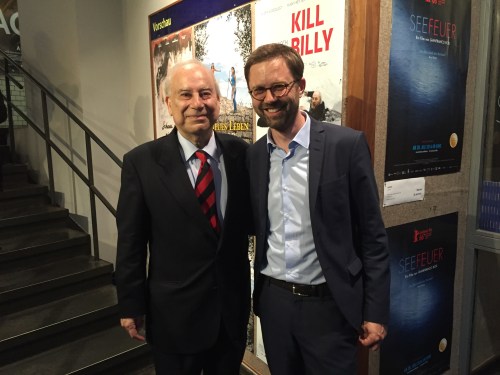
Ambassador Ahmed and Kristiane Backer speak at the European continental premiere of Journey into Europe in Berlin. 

On June 1, the European continental premiere of the Journey into Europe film was held in front of a full house audience at the Hackesche Höfe Kino cinema in Berlin. Ambassador Ahmed introduced the film at the screening, which was co-sponsored by Stiftung Mercator, the principal backer of the project, the British Council, another important backer of the project, and the Aspen Institute Germany. The event was hosted by the author and activist Kristiane Backer, who also moderated a Q and A with Ambassador Ahmed following the screening.
Berlin 2

Ambassador Ahmed with Michael Schwarz, the Executive Director of Stiftung Mercator. 

The Executive Director of Stiftung Mercator, Michael Schwarz, addressed the audience at the screening and in his remarks spoke very warmly about the project and congratulated the team. Rachel Launay, the Germany director at the British Council, also spoke. There were many distinguished guests present, including Anna Kuchenbecker, the Deputy Director of the Aspen Institute Germany, Dr. Klaus Mueller, the United States Holocaust Memorial Museum’s Representative for Europe, Philomena Poetis, representing the Pakistan Honorary Counsel General in Munich, and Brigadier General Asif Adnan Jah Shad, the Defence Attache at the Pakistan embassy in Berlin. All spoke enthusiastically about the film and wanted it shown and circulated widely in venues like schools and centers.

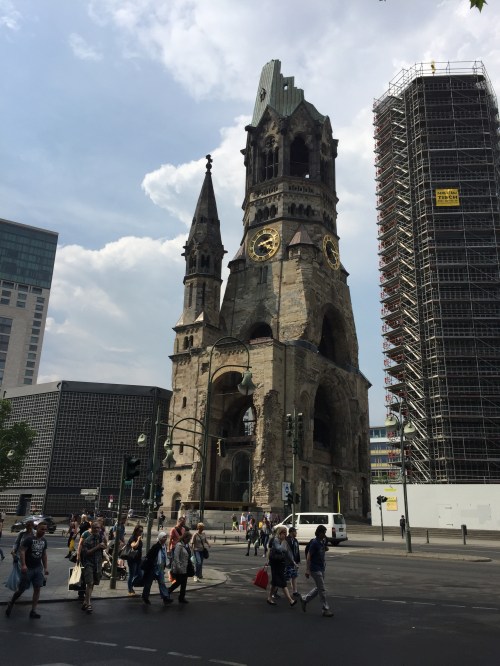
The day following the screening, H.E. Jauhar Saleem, the Pakistani ambassador to Germany, hosted a grand dinner for Ambassador Ahmed at a top Turkish restaurant in the city and invited many distinguished guests. Ambassador Ahmed and the team were also able to do some fieldwork for the upcoming Journey into Europe book, visiting one of Berlin’s most famous landmarks, the Kaiser Wilhelm Memorial Church on the Kurfürstendamm.

Berlin 3

The iconic Kaiser Wilhelm Memorial Church in Berlin.

Ambassador Ahmed presents Journey into Europe at Bradford Literature Festival

IMG_3658

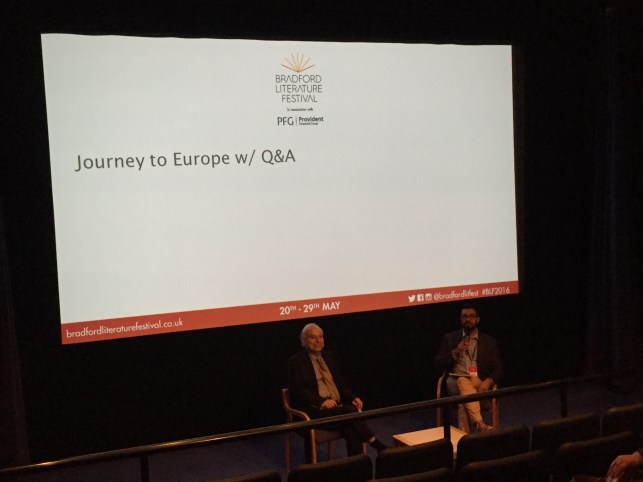
Ambassador Ahmed holds a discussion following the Journey into Europe film screening moderated by the public intellectual Aftab Malik.

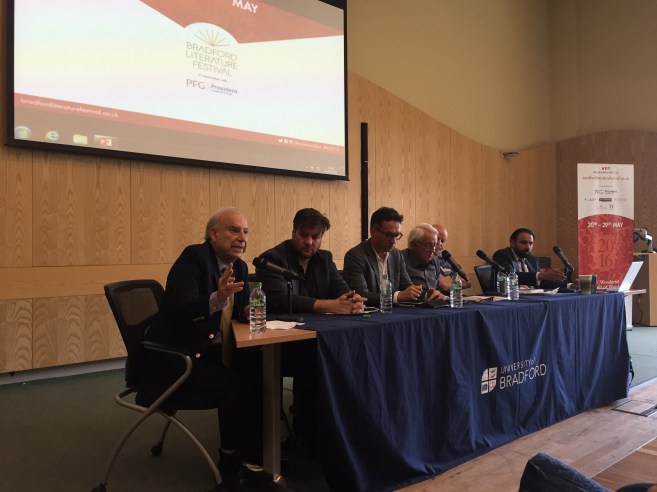
In Bradford, England, Ambassador Ahmed participated in the 2016 Bradford Literature Festival, which ran from May 20-29. On May 28, Ambassador Ahmed presented the Journey into Europe film and discussed the film following the screening and held a Q and A with the audience. The screening was in the National Media Museum’s Cubby Broccoli theater, which is named after the producer of the James Bond films. The film received a very enthusiastic response. Earlier that day, Ambassador Ahmed spoke on a panel entitled “Mainstreaming Hate Speech: The Rise of the Far Right.”

far right

Ambassador Ahmed speaks during the panel discussion, “Mainstreaming Hate Speech: The Rise of the Far Right.”

The Literature Festival is in its second year, and it was an incredible event with some 200 sessions including poetry recitals, performances, lectures, panels, and films. The festival is co-directed by two dynamic Bradford Muslim women, Irna Qureshi and Syima Aslam. The festival was distinctly multicultural with numerous Muslim-themed events such as the evenings devoted to giants of South Asian Muslim literature like Ghalib, as well as English authors like the Bronte sisters, who were from Bradford.

Ghalib

A traditional poetry recitation in honor of the great Ghalib.

Also participating in the festival was Baroness Sayeeda Warsi, one of the UK’s most prominent Muslim political figures. Warsi escalated to fame when she was made a member of the House of Lords and also served as chairman of the Conservative Party. Warsi generously took Professor Ahmed and his family for a magnificent Pakistani breakfast to Zoya, a well-known restaurant in Bradford.

warsi

Baroness Sayeeda Warsi and her husband Iftikhar Azam with Ambassador Ahmed in front of the Zoya restaurant.

Frankie Martin, Zeenat Ahmed, and Mina Hoti joined Ambassador Ahmed in thanking the organizers for their warmth and hospitality and for providing such a wonderful venue for intercultural and interreligious communication.

mina

Team member Mina Hoti enjoying an event at the festival.


Journey into Europe’s Global TV Premiere begins Monday on N1 in Bosnia

N1 in Bosnia, beginning this Monday, will be airing Journey into Europe, subtitled in Bosnian in four parts. Each part will play every Monday in June, corresponding with the month of Ramadan. To learn more (in Bosnian), please visit the N1 website here.

Journey Into Europe: A Discussion With Filmmaker Akbar Ahmed – Wilson Center NOW

For more information, visit the Wilson Center webpage here.

Ambassador Ahmed welcomed by Muslim community in Nottingham, England, and lectures to packed halls

Picture 1

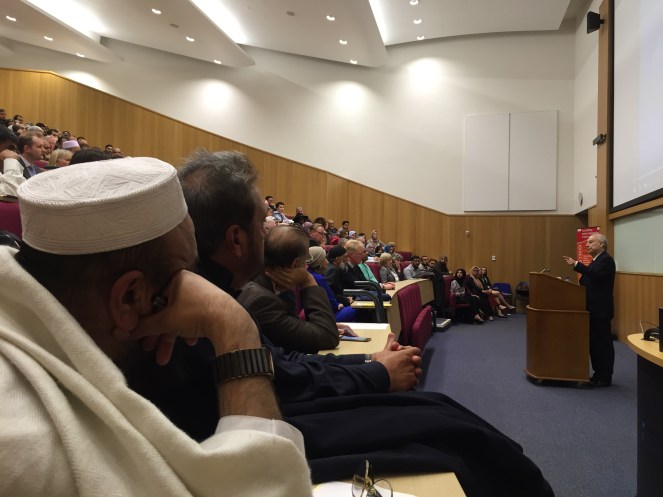
Ambassador Ahmed lectures to a packed hall at the University of Nottingham.

As part of his current lecture and film screening tour, Ambassador Ahmed visited Nottingham, England, where he spent several days meeting the local Muslim community and giving several lectures at the University of Nottingham. Nottingham, a city of around 300,000 people, has about 25,000 Muslims.

Ambassador Ahmed’s visit was co-sponsored by the University of Nottingham and the Karimia Institute, a large Muslim organization and charity based in Nottingham. When Ambassador Ahmed and his team arrived at the train station, they were received by a delegation of the Muslim community, including Dr. Musharraf Hussain, a prominent Islamic scholar and Chief Executive Officer of the Karimia Institute. Ambassador Ahmed and his team were welcomed by the Muslim community in an unending series of dinners and warm hospitality. There was also a tremendous amount of goodwill between the Muslim community and the faculty and students of the University of Nottingham, which was remarkable, and a great spirit of enthusiasm and excitement among the many people brought together by these events to meet and have dialogue with each other.

For most of the world, Nottingham means Robin Hood and Sherwood Forest, and Dr. Hussain drove Ambassador Ahmed and his team to Sherwood Forest to see the famous “Major Oak” tree associated with Robin Hood. At the tree, which is believed to be as many as a thousand years old, Dr. Hussain said that Robin Hood represented the “human desire for fairness and justice” and called him “the protector, savior, and helper of the poor people.”

Dr. Hussain also expressed his desire for interfaith dialogue and friendship in his discussion of the initiative he and other top British imams are taking to celebrate the 90th birthday of Queen Elizabeth II this year on June 10, which falls on a Friday during Ramadan, by saying a prayer for the Queen during Friday prayers. Dr. Hussain called the Queen “a great role model” and “a wonderful lady in every sense” with “64 years of incredible service to humanity and to this country.” “We as Muslims who live in her wonderful realm,” he said, “appreciate her service and her work and this will be a way of thanking her for what she has done for us.”

On May 24, Ambassador Ahmed delivered a lecture titled “Muslims in Europe: Opportunities and Challenges” to a packed hall of around 400 people at the University of Nottingham. The event was opened by Professor Jon Hoover, who teaches Islamic studies at the university and helped arrange and coordinate Ambassador Ahmed’s visit. Ambassador Ahmed was introduced by Professor Katharine Adeney, the Director of the Institute of Asia and Pacific Studies at the university, who said in her introduction that in the 1990s when she was working on her PhD she was inspired by Ambassador Ahmed’s Jinnah book and film and said she couldn’t believe she was now meeting him.Professor Adeney also said that she had been at the university for many years and had never seen an audience as large as it was that evening. There were many distinguished guests present, including the pro-vice-chancellor of the university, who welcomed guests to the lecture, senior professors, and Colonel Stuart Williams, the deputy commander of the famous “Desert Rats” 7th Armoured Brigade who the next day bestowed the honor of “honorary Desert Rat” on Ambassador Ahmed.

Picture 2

Ambassador Ahmed speaks at a press conference at the Karimia Institute convened to launch Dr. Musharraf Hussain’s Trust Building Project. From left to right: Professor Katharine Adeney, Dr. Musharraf Hussain, Ambassador Ahmed, and Professor Jon Hoover.

On May 25th Ambassador Ahmed, who stayed in the huge and stately Hugh Stewart Hall on the beautiful University of Nottingham campus, considered the “greenest” in the world, spent much of the day at the Karimia Institute with the Nottingham Muslim community. Ambassador Ahmed spoke at a press conference in the institute convened to launch Dr. Hussain’s new Trust Building Project, in which trained “ambassadors” from the Muslim community will go out into the wider community in order to forge relationships with non-Muslims and dispel myths about Islam. The event was well-attended by local media and the Muslim community. Ambassador Ahmed was also interviewed for over one hour in Urdu on Radio Dawn, a station serving the local Pakistani community that broadcasts from the Karimia Institute.

At the formal farewell dinner for Ambassador Ahmed held in the grand council chamber of the University of Nottingham hosted by another pro-vice-chancellor, Ambassador Ahmed delivered a speech about trust and shared stories as examples of how to build trust between different communities. The pro-vice-chancellor enthusiastically called the speech “superb.”

The infectious optimism and hospitality of the Muslim community of Nottingham cheered Ambassador Ahmed and the team greatly. The South Asian community knew Ambassador Ahmed through his films Living Islam and Jinnah and they constantly took selfies and photos with him. Everywhere Ambassador Ahmed and his team went they were honored, given gifts, and looked after as very special guests. Members of the Muslim community frequently said to Ambassador Ahmed and his team that they were excited and inspired to have a major Muslim figure in Nottingham and at a perfect time with the launch of the new Trust Building Project dedicated to improving relations between Muslims and the local community, which had been planned for over a year.

There was a feeling that this trip was a catalyst. The visit had accomplished something that had never existed before, bringing the university and the Muslim community very close together. Ambassador Ahmed’s message of promoting interfaith dialogue and friendship resonated with Muslims and non-Muslims alike. As a final gesture of appreciation, an electrical engineer of Pakistani background living in Nottingham personally drove Ambassador Ahmed and his team in his Mercedes to their next stop, Bradford, England, a three hour trip, and refused to accept any payment, repeating that it was an honor for him to drive Ambassador Ahmed. It was a remarkable conclusion to a wonderful and hopeful few days.

Picture 3

Ambassador Ahmed speaks at a formal dinner in the Council Room at the University of Nottingham.

Ambassador Ahmed honored by legendary Desert Rats

IMG_3606

Colonel Stuart Williams presenting plaque and medal of the Desert Rats to Ambassador Ahmed

In Nottingham, Ambassador Ahmed was declared an “honorary Desert Rat” by Colonel Stuart Williams, the deputy commander of the 7th Armoured Brigade, known as the “Desert Rats.” The Desert Rats are a legendary regiment in the British Army honored by Winston Churchill and the German general Rommel alike for their historic role in the North African campaign during World War II.

Journey into Europe to screen at the Bradford Literature Festival, Saturday, May 28, 6p

Anthropologist, Islamic scholar and filmmaker Ambassador Akbar Ahmed explores Islam in Europe and the place of Islam in European history and civilization in this unprecedented study. Shot across the continent in countries including Germany, the UK, France, Spain, and Bosnia, the film introduces us to people from all walks of life: presidents and prime ministers, archbishops, chief rabbis, grand muftis, heads of right-wing parties, and everyday Europeans from a variety of backgrounds.

Join Ambassador Akbar S Ahmed, the Ibn Khaldun chair of Islamic Studies at American University in Washington, DC, for a Q&A after the film.

Tickets: £6
Venue: National Media Museum – Cubby Broccoli Cinema

For more information, please visit the Festival website here.